
Guide
Getting Started with Idiomind
A tool for learning words and expressions through personalized notes, contextual information, and spaced repetition.
Instead of learning from a predefined vocabulary, build your own collection from the language you encounter in everyday life: a conversation, book, website, film, photograph, document, or any other source.
How Idiomind works
Idiomind turns the language you meet into material you can review. Each note goes through the same path:
Start with something you genuinely want to remember. In five minutes, you can create a useful topic and begin practising it.
Understanding notes and topics
Notes
A note is a word, expression, or short sentence that you want to learn. It can contain the original text, its translation, an optional image, and grammatical information through word colours.
Example
although → aunque
Although it was raining, we went for a walk.
Aunque estaba lloviendo, salimos a caminar.
A note can contain up to 150 characters, making it suitable for vocabulary, expressions, and short examples rather than long texts.
Topics
A topic is a collection of related notes. It can be a place, situation, subject, vocabulary group, or a source such as a book.
Example: At the airport
boarding pass → tarjeta de embarque
departure → salida
Where is gate twelve? → ¿Dónde está la puerta doce?
The flight has been delayed. → El vuelo se ha retrasado.
Organizing vocabulary by how you encountered it makes each topic more meaningful than a single large list of dictionary words.
Make better notes
A note does not have to be text-only. Associate an expression with an image, screenshot, or visual context when useful—especially for objects, places, people, signs, menus, situations, and visual vocabulary.
- Save phrases, not only isolated words.
- Keep one idea per note.
- Add where or when you would use the phrase.
- Create focused topics of 10 to 30 notes.
- Review a little, often.
Your first topic in 5 minutes
The best way to understand Idiomind is to build one small topic. These are the five actions you will take, end to end.
Choose one clear purpose
A topic is a focused collection of notes. Create one for a real situation, such as Ordering food, English for meetings, or Phrases from a film.
Add five useful notes
Add complete phrases whenever possible. A phrase shows how the language is actually used and is easier to recall in conversation.
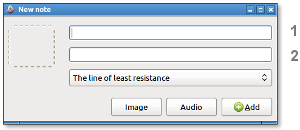
Enter the phrase in the upper field (1), enter its meaning in your native language in the lower field (2), then click Add. You can write the translation yourself or use the automatic translator.
Tip
Select text anywhere on your computer and click Add to use the selected text directly.
This is especially useful when studying from web pages, electronic books, documents, subtitles, and other applications. It reduces the distance between encountering a useful expression and adding it to your learning material.
Add context
Give each note just enough information to recognize it later: a translation, a short example, an image, or a pronunciation cue.
Example
Could I get this to go?
¿Me lo puede dar para llevar?
Use it when ordering food in a restaurant.
Automatic translation
If you do not know the translation, Idiomind can use an online translator. Treat automatic translation as a starting point: ambiguous words and idiomatic expressions may need a correction based on their context.
Practise your topic
Try to recall the meaning before revealing the answer. Be honest with your result: Idiomind uses it to help you focus on what still needs practice.
Return when prompted
Idiomind spaces reviews over time. Short, regular reviews are more effective than trying to memorize everything in one session.
The learning loop, at a glance
- Create a topic. Choose a subject or situation.
- Add a few notes. Save words and expressions relevant to you.
- Add context. Use translations, images, or screenshots when useful.
- Review. When Idiomind notifies you, review the topic.
- Repeat later. Successful reviews increase the interval before the next one.
That loop is what runs again and again, in the background, once you have your first topics. The next two sections explain what happens while it runs.
Remember
Don't try to build the perfect topic. A small collection of useful expressions is more valuable than a large collection you never review.
Understanding reviews
Idiomind uses spaced repetition. You do not need to review a topic every day: it gradually increases the time between reviews, from approximately 6 days to 2 months.
If a topic is still difficult, it returns for review sooner. As your memory becomes stronger, the interval becomes longer.
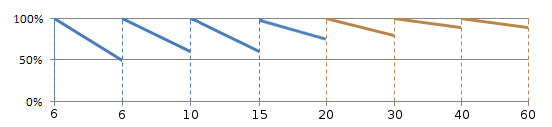
What the graph means
- New topics require more frequent reviews.
- Mature topics can remain unreviewed for longer periods.
- Successful reviews generally lead to longer intervals before the next review.
Why intervals increase
After learning something, its accessibility tends to decrease with time. Reviewing reinforces the memory and makes it possible to postpone the next review. A topic successfully reviewed several times does not need to be treated in the same way as a newly created topic.
New and mature topics
New topics have not yet accumulated enough successful reviews and require more frequent attention. Mature topics have already passed through the learning process several times, so the interval before their next review can be longer.
Estimated memory retention
The review system represents retention as an estimate from 0% to 100%, based on review history and elapsed time. It is not a direct measurement of your biological memory; it indicates why a topic is likely to appear for review at a particular moment.
Higher estimated retention → longer review interval
Lower estimated retention → sooner review
Understanding review status
Each topic displays an icon indicating its current learning state. These states correspond to the intervals described above.
| Status | Meaning |
|---|---|
 new new | The topic has not been reviewed yet. |
 mature mature | The topic has been reviewed successfully several times. |
 learnt learnt | The topic has reached a high level of retention. |
 reviewing reviewing | The topic is currently being reviewed. |
 to review to review | A review is due. |
 second notice second notice | A review is overdue and has been notified again. |
Optional tools
Add an image
Click Image, then drag over the area of the screen you want to capture.
Add text from an image
Use OCR to extract text from a photograph, scanned document, screenshot, sign, or other image. Enter i in the Add Note field, click Add, and select the area containing the text.
Image preserves visual context. OCR extracts the language contained in that image.
Process several pieces of text
Select blocks of text with the mouse for batch processing when several expressions from the same source belong in a topic.
Word colours
Use colours to identify the grammatical role of a word.
| Category | Use |
|---|---|
 pronoun pronoun | pronouns |
 verb verb | verbs |
 adjective adjective | adjectives |
 preposition preposition | prepositions |
 adverb adverb | adverbs |
 conjunction conjunction | conjunctions |
 noun or adjective noun or adjective | words that can have both roles |
 noun or verb noun or verb | words that can have both roles |
Example
The old (adjective) man (noun) walks (verb) slowly (adverb).